What Is a Midlife Crisis?
So I asked Chat GPT (don't we all) what a midlife crisis in men and this is what he came up with. My comments below.
Now that I think of it, I did see this in some men.My brother had 2 motorcycles in is 30s, he quit for a while, in hid 40s bought a dirt bike than a second bigger one. Another firend bought a scooter (also used to have one when he was younger). It was a 400cc big Yamaha majesty just so "it would be harder to steal). Wouldn't mind a convertible myself, but ony if I win the lotto.. What Is a Midlife Crisis?
A midlife crisis is a period of emotional turmoil or deep self-reflection that some men experience, typically between their late 30s and mid-50s. It is often triggered by the realization that life is finite and that certain goals, identities, or dreams may no longer be attainable—or may need to be redefined.
Importantly, not all men experience a midlife crisis. For many, midlife is a time of stability or growth. The term describes a pattern of responses rather than an inevitable life stage.
Realisation life is finite.... I got that at 22 when a friend of the same age died of a sudden stroke. I also got reminded of that at 39 when a friend passed away after a 5 year battle with cancer. And each time it prompted me to action
2. Common Emotional and Psychological Signs in Men
Men experiencing a midlife crisis may show a combination of internal struggles and outward behavioral changes. Common signs include:
Emotional and Psychological Indicators
Persistent dissatisfaction or restlessness
Feelings of emptiness, regret, or lost purpose
Heightened anxiety about aging, health, or death
Depression or irritability without a clear cause
Identity confusion (“Who am I beyond my job or role?”)
Behavioral Changes
Impulsive decisions (career shifts, major purchases, sudden lifestyle changes)
Increased focus on youth or appearance
Withdrawal from family or long-term relationships
Risk-taking behaviors or escapism
Nostalgia or obsession with “roads not taken”
Men often struggle silently during this phase, as social norms may discourage emotional vulnerability or asking for help.
I suppose it's a reaction to the roles we now have to play, as provider, family support, chauffeur, luggage carrier, handyman and whatever else may be needed.
3. Origins of the Midlife Crisis Concept
Psychological Roots
The term “midlife crisis” was popularized in 1965 by Canadian psychoanalyst Elliott Jaques, who observed that many adults confronted mortality and reassessed life goals around midlife.
Later, developmental psychologists such as Carl Jung emphasized midlife as a turning point—shifting focus from external achievement to internal meaning.
Cultural Influence
The idea gained traction in Western cultures, particularly in post-war societies where:
Male identity was strongly tied to career success and productivity
Linear life milestones (education → career → retirement) were emphasized
Aging was increasingly viewed as decline rather than transformation
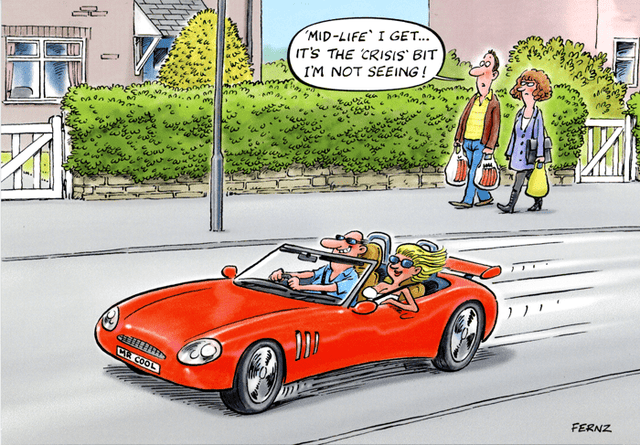
Media portrayals—sports cars, affairs, drastic career changes—helped solidify the stereotype, even though real experiences are often subtler and more introspective.
Sure, I get some recognition in my job (I've mastered plenty of those, and I'm a trainer also), but I need something beyond Job and family to identify myself. A hobby sure helps, but with motorcycling gone (too dangerous and too much time away from family) and mountaineering also gone (too out of shape and also away from family) and scrutineering for motorsport events (too much time away from family; sensing a pattern here), what else is there?
Oh I know, I'll try writing. I used to love blogging when I was younger; people seemed to like my tribulations. I can do that at home ! I'll realise my teenage dreams of writing a novel and have something that will outlive me.
4. Is a Midlife Crisis a Myth?
Modern research suggests that:
Midlife dissatisfaction is not universal
Emotional well-being often follows a U-shaped curve, with midlife dips followed by improvement later
What’s labeled a “crisis” is often a normal developmental transition
In other words, midlife challenges are real, but they don’t have to be destructive—and can be deeply constructive.
5. How Men Can Recognize a Midlife Crisis Early
Early awareness can prevent unnecessary distress. Warning signs include:
Chronic feelings of “something’s missing”
Loss of motivation for previously meaningful activities
Fantasizing excessively about starting over
Measuring self-worth only through past achievements
Recognizing these signals as information, not failure, is key.
Here's the problem: my chosen topic for my novel is a former love affair, a formative one at that. I see how you may think this is about the fantasy of starting over, except that... it isn't.
On the first date with the girl she told me she wanted to get married and have children as soon as she finished high school (so in abou 1 year from that date ). I was on my first job, just out of college and wanting to enjoy some financial freedom and traveling, so clearly not the same goals. I'eve never imagined myself married to her, neither then nor now, so it's not starting over or roads not taken. I did spent quite some time grieving from that relationship and trying (and finaly succedding) to finally see her as just a friend, some who could listen without judging and help me make sense of what I was feeling.
Is it me looking back to when I was younger and maybe had more freedom? Definitely. Is it me trying to show others what I lived through and leaving something behind after I myself am gone? I think so.
Of course I could have chosen another topic, but isn't writing supposed to be about what you know? I do hope to write something more fictional in the future . Of course I'm hoping I can share this work with people and that they will like it. If they don't, I won't bother with the second one :p
6. Healthy Ways to Manage or Avoid a Midlife Crisis
1. Reframe Midlife as a Transition, Not a Verdict
Shift from:
“Time is running out”
to“Time is changing—what matters now?”
Midlife often brings greater emotional intelligence, perspective, and autonomy.
2. Redefine Success and Identity
Expand identity beyond work or status:
Relationships
Creativity
Mentorship
Personal values
Contribution rather than competition
3. Make Intentional, Not Impulsive, Changes
Change is healthy—but reflection should precede action. Pause before drastic decisions and ask:
Is this aligned with my values, or just an escape from discomfort?
4. Invest in Physical and Mental Health
Regular exercise and sleep
Reduced alcohol and stress coping through healthier outlets
Mindfulness, journaling, or therapy
Physical well-being strongly influences emotional resilience.
5. Strengthen Relationships
Meaningful connections buffer against existential anxiety.
Talk openly with trusted friends or partners
Seek peer groups or mentors navigating similar life stages
6. Embrace Purpose Over Youth
Instead of chasing youth, many men thrive by cultivating:
Purpose
Wisdom
Legacy
Depth over novelty
7. A Healthier Perspective on Midlife
A midlife crisis is not a sign of failure—it’s often a signal that growth is required. When approached with curiosity rather than fear, midlife can become a period of renewal, clarity, and alignment with what truly matters.
For many men, the real challenge is not aging itself, but learning how to live the second half of life with intention.
If you’d like, I can also explain how midlife transitions differ between men and women, or how personality, culture, and life circumstances influence whether a crisis occurs.

Comments
Post a Comment
Please keep your comments civilised